

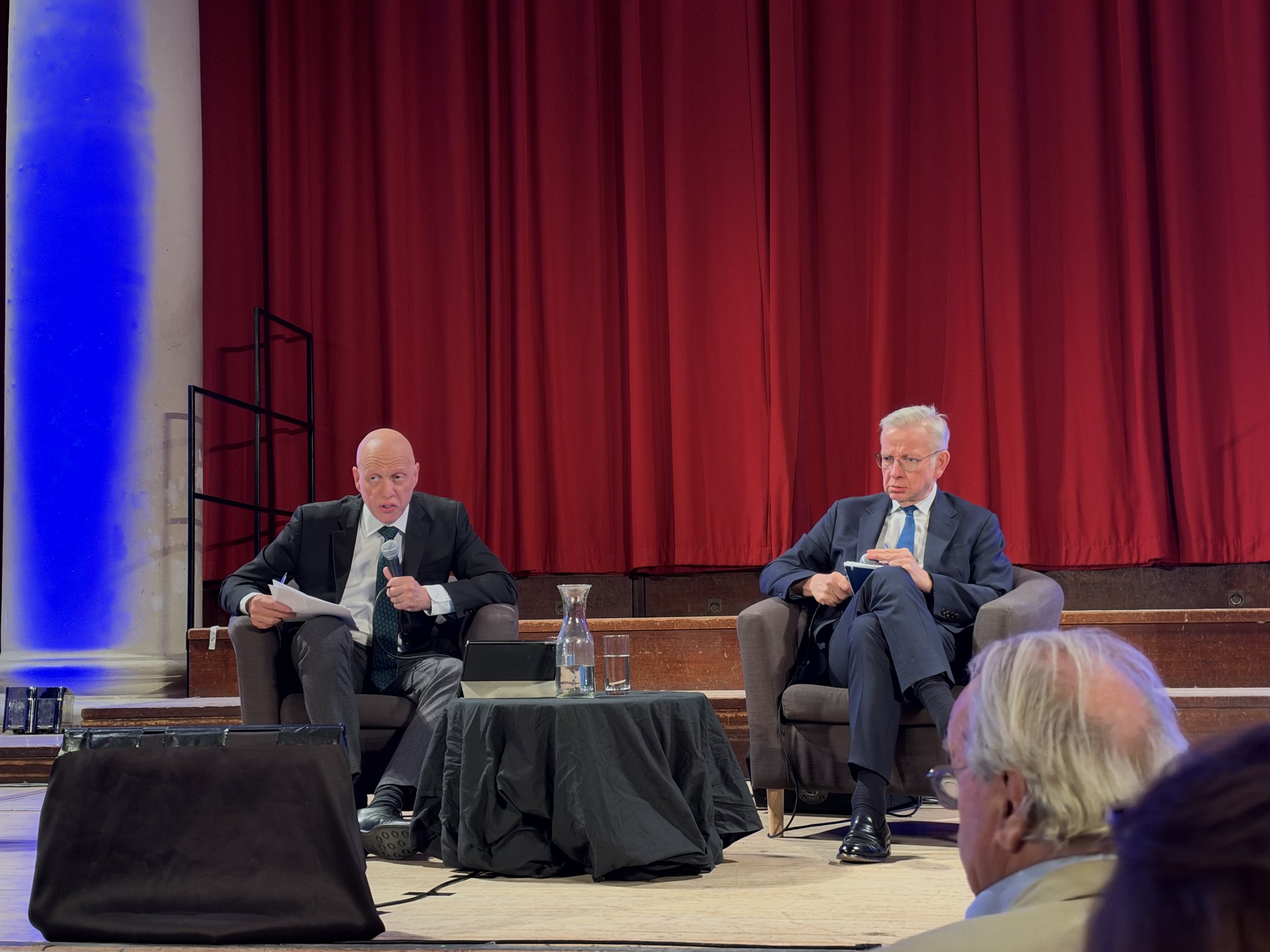
Earlier this week I was at Smith Square Hall in Westminster for the Intelligence Squared Economic Outlook, with Michael Gove in conversation with the BBC's Jonny Dymond. It was a thoughtful evening on productivity, investment and next week's Budget. But the moment that drew the biggest laugh, and the one that has stayed with me since, was Gove's account of the "Fish Disco" at Hinkley Point C. The most effective music for scaring fish away, he told us, turns out to be 70s disco.
Having spent most of my career in construction procurement, I laughed along with everyone else. Then I went home, did some digging, and stopped laughing quite so much.
Saturday Night Fever in the Severn Estuary
For anyone who missed it, here is the story. Hinkley Point C in Somerset will draw its cooling water from the Severn Estuary through two tunnels, each around 3km long, at roughly 120,000 litres every second. That is a lot of water, and inevitably a lot of fish!
To stop them, the project is installing three separate fish protection systems. According to the Government's Nuclear Regulatory Taskforce review, led by John Fingleton, these are low velocity side entry intake heads at £500m, a fish recovery and return system at £150m, and an acoustic fish deterrent at £50m. The last of these is the famous fish disco, a nickname Gove himself coined back in his days as Environment Secretary. In reality it is a large array of underwater speakers emitting high pitched sound pulses, reported to be louder than a jumbo jet. I am sorry to report that, despite Mr Gove's best efforts, there is no evidence of the Bee Gees being involved.
In fairness, the disco works. Trials carried out by Swansea University and reported in February found that with the deterrent switched on, only one tagged twaite shad came within 30 metres of the intake heads, compared with fourteen when it was switched off. The Guardian reported that the measures could save around 90% of fish from the intake pipes. So far, so good.
Don't Stop 'Til You Get Enough
Where it gets uncomfortable is the arithmetic. The Fingleton review set out the developer's own modelling of what the full £700m package would save in protected species each year: 0.083 salmon, 0.028 sea trout, 6 river lamprey, 18 allis shad and 528 twaite shad. On one widely reported calculation, that works out at around £280,000 per fish saved over 25 years.
By way of comparison, the same review cited a project that removed a weir and reopened up to 160km of natural habitat to salmon, at a cost of around £100,000. That is roughly a third of the price of saving a single fish at Hinkley.
Now, I am a Chartered Surveyor and not a marine biologist, so in the interests of balance it is only right to say the numbers are contested. The Wildlife Trusts and fourteen other environmental groups argue the review overstated the case, pointing out that the deterrent itself costs £50m, not £700m, and that Environment Agency research suggests up to 4.6 million adult fish a year could be killed without protection. The Institute of Fisheries Management notes that the measures represent around 0.12% of the project budget and were originally selected by the developer itself.
Those are fair points, and the lesson here is certainly not that fish do not matter. The lesson is that nobody appears to have been required, at any stage, to put a price tag next to each option and ask whether the same money could do more good for nature somewhere else. One of Fingleton's recommendations is that developers should include a cost estimate in their environmental assessment for any mitigation measure likely to exceed £500,000. The fact that such a recommendation needs making at all tells you a great deal.
Disco Inferno: The Bigger Picture
The fish disco is a symptom, not the disease. Hinkley Point C was estimated at £18bn in 2017; the BBC now reports an estimate of around £46bn, with opening expected in 2031. Nobody, including Fingleton, suggests fish protection is the main reason for that. But it is part of a pattern, and the fish are not dancing alone.
On HS2, the Sheephouse Wood bat protection structure in Buckinghamshire, built to protect a colony of Bechstein's bats, was originally budgeted at £40m and has since risen to around £100m. The then HS2 Chair, Sir Jon Thompson, told an industry conference that more than 8,000 permits had been needed along the route.
Closer to home for me, the Lower Thames Crossing was first mentioned in Parliament some 36 years ago. Its planning application ran to 359,866 pages, including around 1,800 pages on newts and 774 on bats, and National Highways spent close to £300m on the application alone. Laid end to end, the documents would stretch 66 miles, nearly five times the length of the road itself. In the time it took to secure consent, the cost of the scheme rose from just over £4bn to more than £10bn.
Meanwhile, on Other Dance Floors
So what do other countries do differently? My instinct was that China simply gets on and builds things, and to a large degree that is true. China's standard construction programme for its Hualong One reactor is five years, with units already in operation taking between five and seven and a half years from first concrete to grid connection. In 2025, fifteen Hualong One units were at various stages of construction. They are not reinventing the wheel each time; they build the same design again and again, and get quicker and cheaper as they go.
It is not only China. In the UAE, a South Korean led consortium began building the four reactor Barakah plant in 2012. It was not without its own delays and overruns, with the original $20bn budget rising to somewhere between $24bn and $32bn depending on the source, but the result is four large reactors and around 5,600MW of capacity. Hinkley Point C will deliver 3.2GW.
Transport tells the same story. Britain Remade's analysis of more than 200 projects across 14 countries found that UK tunnelling costs around £676m per mile, twice the cost of Italy or France, three times Germany and around six times Spain. Phase 1 of HS2 is estimated at £396m per mile, more than eight times the Tours to Bordeaux high speed line. Madrid tripled the length of its metro system in just twelve years, while London's Jubilee Line Extension, built over the same period, cost nearly ten times as much per mile.
In the interests of fairness, it is not simply a case of "Britain bad, everyone else good". France's own Flamanville 3 reactor took seventeen years to build, was connected to the grid twelve years late in December 2024, and cost around four times its original budget. A French report found that construction had started before the design was complete, so parts of the work had to be demolished and rebuilt. Any construction professional reading that will wince in recognition. Nor would many of us want China's approach to public consultation imported wholesale. But somewhere between a one party state and a 359,866 page planning application, there must surely be a sensible middle ground.
Ain't No Stoppin' Us Now? The Budget
The good news is that Government appears to be listening. The Planning and Infrastructure Act 2025 received Royal Assent last December, introducing a Nature Restoration Fund so developers can pay into strategic habitat improvement rather than funding project by project mitigation, and abolishing the paper permission stage for judicial reviews of nationally significant infrastructure.
Next Wednesday, 28 October, Chancellor John Healey delivers his first Budget. In his Coventry speech in September he pledged to cut the burden of business regulation by 25% by the end of this Parliament, to extend judicial review reforms from energy to all major infrastructure projects, to investigate why building railways in Britain costs so much more than in comparable countries, and to reduce the Green Book discount rate from 3.5% to 3% to favour projects with long term benefits. This week he has signalled that reducing the cost of doing business will be a central theme, potentially including cutting red tape for smaller firms. Until the Budget documents are published, of course, these remain signals rather than measures.
If they materialise, they should be welcomed. But speaking as someone who has spent a career on the procurement side of the fence, I would gently add that red tape is only half the problem. The other half sits with us as clients and as an industry: stop start pipelines that destroy supply chain confidence, designs that are not finished before we start building, every project treated as a bespoke prototype, and a reluctance to bring contractors and the supply chain in early enough to challenge the brief. A proportionality test on environmental mitigation is a good start. A proportionality test on how we plan, procure and deliver the whole project would be even better. The use of a collaborative contract, with early supply chain involvement should be a must.
The Last Dance
The fish disco should not make us cynical about protecting nature. Quite the opposite. It should make us demand that every pound spent on mitigation does the maximum possible good, whether that is a speaker in the Severn or a weir removed from a river further upstream. Above all, it should make us ask why, as a nation, we seem to have made building anything quite so extraordinarily difficult.
So when the Chancellor rises at the dispatch box next Wednesday, I will be listening carefully for evidence that we are finally ready to get on with it. If not, perhaps the fish could put in a song request. I would suggest "Stayin' Alive". At £280,000 a head, they have certainly earned it.
Find out more
Neil Thody is a Fellow of the RICS, leading procurement specialist, CEDR/RICS Mediator, RICS Adjudicator, Expert Witness and Independent Adviser, working with clients across multiple sectors.
Links
Intelligence Squared: The Economic Outlook with Michael Gove (19 October 2026) and YouTube recording
Nuclear Industry Association: Hinkley Point C and fish protection
Envirotec: Nature groups respond to the Nuclear Regulatory Review
The Spectator: The Lower Thames Crossing and the failure of the British state
Construction Briefing: Lower Thames Crossing application runs to 359,000 pages
Oenergetice: China begins construction of six-unit Jinqimen plant (Hualong One programme)
London Reconnections / Britain Remade: infrastructure cost comparisons
London Assembly: Why London pays more for transport infrastructure
Power Magazine: Flamanville 3 and NucNet: Flamanville 3 fuel loading
Trustnet: Healey pledges to cut business red tape by 25% (7 September 2026)
HNGN: What Healey's first speech tells us about the 28 October Budget